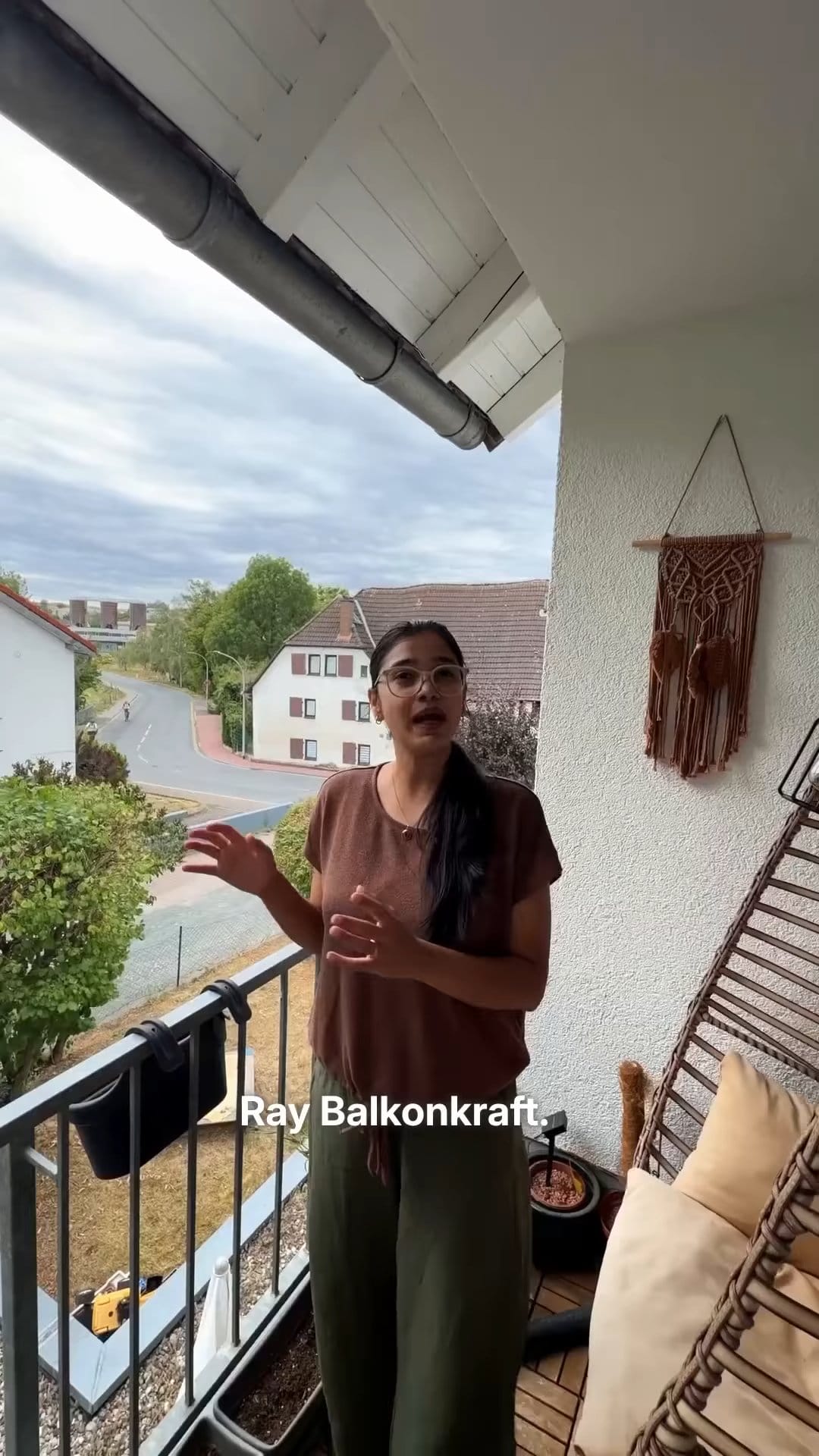
Ad_ this post includes an affiliate partnership with Sunshare, the maker of the Ray Balkonkraftwerk. I installed one on my south-facing balcony in Germany, and this guide covers what a Balkonkraftwerk actually is, whether it is legal on a rented balcony, what it costs, and what I have seen so far from the Sunshare Ray.
What is a Balkonkraftwerk?
A Balkonkraftwerk (balcony power plant, also called Stecker-Solargerät or plug-in solar) is a small solar system, usually one to four panels plus a micro-inverter, that plugs into a normal household socket and feeds electricity directly into your apartment’s circuit. It does not power the whole building or the grid; it just offsets what you are already drawing from your own socket, lowering your electricity bill while it is generating.
For renters and apartment dwellers, a Balkonkraftwerk is one of the few ways to generate your own solar electricity without owning the roof. That is also why it has become popular with Indians and other expats living in German apartments: no landlord-owned rooftop needed, and the hardware travels with you if you move.
Is a Balkonkraftwerk legal on a rented balcony in Germany (2026 rules)?
Yes, and the rules got simpler in the last two years. Here is where things stand in 2026:
- Landlord permission: since 2024, balcony power plants are a “privileged measure” under German tenancy law (§554 BGB) and condominium law (§20 WEG). A landlord or Hausverwaltung can no longer refuse installation without a genuine reason — they can ask about how it is mounted, but a blanket “no” does not hold up.
- Registration: every Balkonkraftwerk must be registered in the Marktstammdatenregister (MaStR), the Bundesnetzagentur’s plant register, within one month of switching it on. Registration is free, takes a few minutes, and (since Solarpaket I, May 2024) a separate notification to your grid operator is no longer required — the MaStR forwards it automatically.
- Power limits: to qualify for the simplified process, the inverter feed-in must stay at or below 800 W (VDE-AR-N 4105:2026-03), with a module limit of up to 960 Wp allowed on a standard Schuko plug (DIN VDE V 0126-95). The Sunshare Ray’s 800 W inverter is built around exactly this limit.
- Electrician sign-off: not required for plug-in systems within these limits. A normal Schuko socket is sufficient; you do not need an electrician to install a compliant Balkonkraftwerk.
Skipping MaStR registration is not a minor paperwork issue — it is an administrative offense under §95 EnWG, and the Bundesnetzagentur can fine you for it. Since it takes about ten minutes and is free, there is no real reason to skip it.
Before you order anything: tell your landlord or Hausverwaltung you are installing one, and check your Mietvertrag for any balcony-specific clauses. The law is on your side, but a heads-up avoids friction, especially if the mount attaches to the railing itself.
How much does a Balkonkraftwerk cost, and what does it save?
Balkonkraftwerk sets are sold by module count, from a single 200 W panel up to six panels (1,200 Wp), paired with an 800 W inverter (the legal feed-in cap). Sunshare’s own calculator estimates that an 800 W south-facing setup produces roughly 1,122 kWh per year, which works out to about €157/year in savings at a €0.40/kWh electricity price — and German electricity is usually more expensive than that, so real savings can be higher depending on your tariff.
| What | What to check |
|---|---|
| Entry price | Single-panel (200 W) Sunshare Ray sets start around €209 (list price €374) — larger sets and battery add-ons cost more; always check the live configurator price, since promos change often. |
| Annual output (800 W, south-facing) | ~1,122 kWh/year (vendor estimate) |
| Estimated annual savings | ~€157/year at €0.40/kWh — scales with your actual electricity price |
| Rough payback | Depends on final price paid, mount cost and orientation — sunnier, south-facing balconies pay back faster than shaded or east/west ones |
| 0% VAT | Since Jan 2023, PV components including Balkonkraftwerk sets are VAT-free in Germany (§12 Abs. 3 UStG), so the sticker price is the final price |
The real payback time depends heavily on how much sun your balcony actually gets, whether you are home during daylight hours to use the power as it is generated (a Balkonkraftwerk without a battery only offsets electricity you use at that moment), and the final price you pay after any discount code.
How to register your Balkonkraftwerk (MaStR, step by step)
- Go to the Marktstammdatenregister portal (marktstammdatenregister.de) and create an account.
- Confirm your email and log in.
- Register yourself as an “Anlagenbetreiber” (plant operator) with your name and address.
- Register the new system, choosing the plug-in/balcony solar installation type — not “regular PV system,” which asks for different, more complex proof.
- Enter the basic details: module power, inverter power, installation address, commissioning date.
Do this within a month of switching your Balkonkraftwerk on. No electrician certificate, no separate grid-operator form — MaStR handles the rest automatically.
My experience with the Sunshare Ray Balkonkraftwerk
I installed the Sunshare Ray on my south-facing balcony. A few things stood out about the design and why I picked it over a standard two-panel set:
- Modular panels: instead of one or two large panels, the Ray uses several compact 200 W N-type modules (only 7.5 kg each) that you can spread across the railing individually. That made it easier to fit my balcony’s layout and reduced shading from the railing bars compared to one big panel.
- 800 W inverter: the Sunshare MWR-800 stays right at the German legal feed-in limit, with dual MPPT tracking and app connectivity to monitor output.
- Adjustable mount: the bracket fits railing thicknesses from 30–120 mm and tilts 0–30°, which the vendor says adds around 30% more output versus a flat mount — worth using if your railing allows it.
- Build quality on paper: VDE/TÜV certified, IP68-sealed panels, rated for wind up to level 12 and hail up to 25 mm. I have not been through a real storm season with it yet, so I cannot personally verify durability long-term.
- Install: no electrician, no drilling into the building structure — the mount clamps onto the railing and the inverter plugs into a normal outdoor-rated Schuko socket.
I am tracking electricity production and savings over the next few months and will update this post with real numbers instead of vendor estimates once I have enough data.


Sunshare Ray discount code
Sunshare is running an End-of-Summer sale at the time of writing. Use code ertiqua at sunsharetek.com for an additional 6% off orders over €164. Promo terms and prices change, so check the live price and code validity before ordering.
Before installing, always confirm with your landlord or Hausverwaltung, even though German law is on the tenant’s side for this specific type of installation.